Opportunity-induced Collective Paranoia


Have we already forgotten what a centrist party is?


October 24, 2026

I was going to write about the potential harms that National and Labour’s social media ban would bring, as I consider this not only to be an important issue going into an election, but it concerns me greatly that this is being pitched as some panacea for the struggles of our young people without a solid evidence base to justify it. 
However, I find myself getting more and more concerned at what seems to be a breakdown in critical thinking among the people of this country. Perhaps it’s more global than that – but I’m restricting myself to observing a phenomenon that’s both compelling and immediately relevant to this year’s general election. 
To be clear, I’m an undecided voter, and have not openly supported any political party since 2013. 
I still don’t know who I’ll vote for this year. 
I don’t tend to make my mind up until I walk to the polling booth. 
However, I’ll admit – I’ve been remarkably impressed with both the polling performance of the Opportunity Party, and their leader, Qiulae Wong’s debate performance – particularly when going head-to-head against Winston Peters. Despite that, I consider myself a left leaning observer in the dynamics, and particularly the psychology and philosophy, of both the leaders and the general public’s beliefs and actions going into this election. 
I have previously written about my rejection of instrumental/tactical voting, and how I consider voting to be a form of self-expression, whereby I consider my vote to be a declaration supporting a particular Kaupapa or candidate. I explicitly reject the more instrumental notion of voting as grotesque and unpalatable as we leave the fate of our society to the outcome a perverted game. For me, voting is a conscious choice that declares “this is a Kaupapa I support, and this is who I stand by”. Nothing more. 
I consider this a particularly valuable position to share my observations about the mindset and reasoning fallibilities of the general public – as this election appears quite unique with regard to both. I don’t think I’ve seen such a toxic and desperate election since 2005. 
What I’ve observed over the past few months is some kind of distrust of Opportunity because they have been transparent about their willingness to work with either National or Labour in coalition. I fear that we have become so tribal in our politics, that not only does the left vs right distinction no longer refer to any unifying philosophy or standpoint, instead we need to know where a person stands on the political spectrum to assess who they really are, and whether they’re friend or foe. 
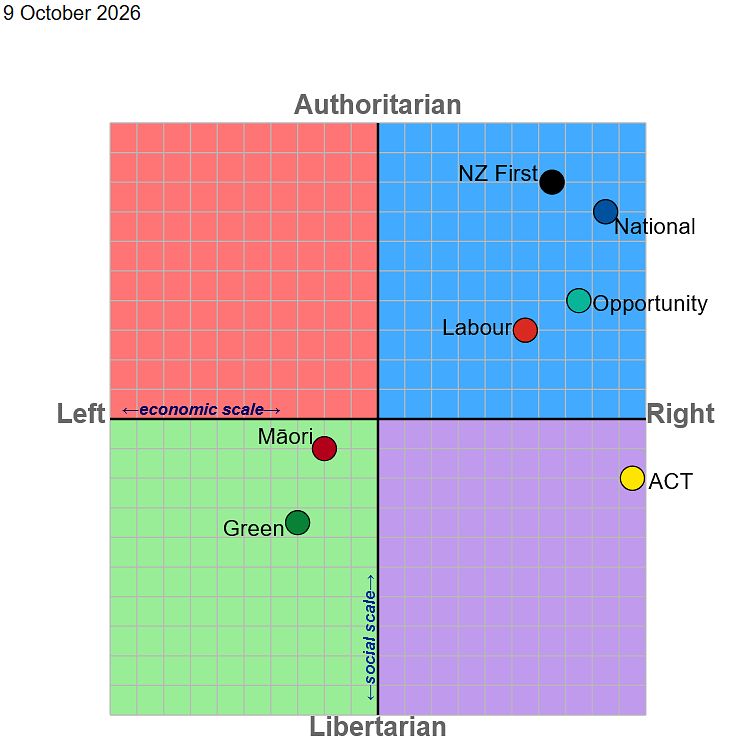
Consider, for instance, that the official political compass website, which has maintained a graphic for every NZ election since 2008, placing each of the viable candidate parties on their dual axis chart, has moved Labour further and further to the right throughout that time, where they now sit firmly in the centre of the right half. Anyone who didn’t know anything about New Zealand politics would assume, based on this chart, that Labour are a right wing party – and that most parties in this country are firmly right wing. Yet they appear to be the only people who would claim this. 
Why? 
Because the political compass still defines right vs left on economic terms only. That’s how it was defined 20+ years ago. Since then, it became a social/ethical orientation, and now it seems only to refer to which team a person identifies with – like the All Blacks vs the Springboks. It no longer means anything other than that. And the jarring disconnect that the political compass authors have with the rest of us is testament to this point. Left wing and right wing are now used both as terms of identification as much as they are terms of insult. Just like a sports team. 
So where on earth does a centrist party fit in amongst all this? 
It doesn’t. 
If you don’t outright support our side or the other side, and signal that you could support either side – then neither side trusts you. Many folks will be suspicious of you. 
This is where the idea of “collective paranoia” comes in. Because we have a need to figure out which team an undeclared party must be supporting, even if only in secret, we’ll come up with theories about hidden loyalties that extend well beyond any evidence available to us. And it’s almost always a hidden loyalty to the “other” team. We’re a risk averse species. 
This isn’t to accuse individuals of being paranoid to a clinical degree. I’m not saying anyone is having some psychotic episode because they don’t trust Opportunity. I’m simply saying that what I’m seeing on social media is such a bizarre and extreme form of paranoia, that it warrants being called out for what it is. 
In the few exchanges I’ve had on social media, particularly on TikTok, on this topic – I too have been accused of both being a communist and an Opportunity supporter – merely because I’ve tried to call this out immediately as, where, and when I’ve seen this paranoia. 
We have become so tribal, that defending a party’s right to be represented by their Kaupapa, and not anyone’s paranoid inferences about hidden allegiances, is now seen as a direct endorsement of that Kaupapa. As though a defence lawyer who is merely doing their job of ensuring their clients right to be fairly represented and heard, is somehow supporting the crimes the accused is suspected of committing. 
It seems that any person who calls out shoddy thinking and conclusions devoid of necessary evidence is now accused of batting for the other team. Which I unfortunately can’t help myself from doing, especially on TikTok. 
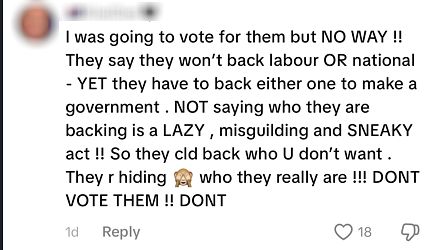
Consider this comment, left on a Spinoff video about Opportunity: 
This person seems to indicate that any political party must back EITHER National or Labour, whereby they express their suspicion about Opportunity’s failure to do this.

It has only been 9 years since Dunne’s United Future was suddenly voted out of parliament, having worked with both Labour and National governments under a supply and confidence deal for 15 years, with varying numbers of seats in the house in their name throughout that time. I don’t recall this level of paranoia being present in speculation about whether Peter Dunne will side with one or the other and dismissed as untrustworthy at any point during that time.

Regardless, both this precedent, and basic rules of logical reasoning, show that this person’s claim illustrates the false dilemma fallacy – a reasoning error that assumes there must only be two possibilities in the mind of the person making the decision. My own writing about what voting is to me shows that such considerations about political allegiances aren’t even necessarily applicable here. 

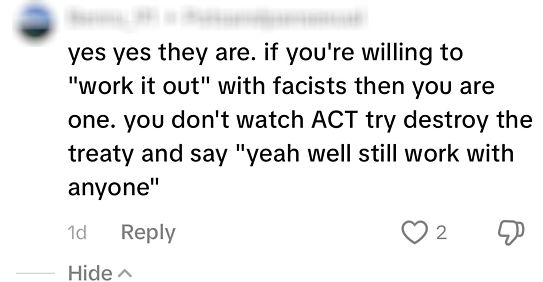
In another discussion thread on that video, a person noted that their existence as a queer person was not up for debate and their ability to speak Māori wasn’t either. When someone rightly pointed out that Opportunity did not challenge either of these, that person replied that a willingness to work with people who might believe this (even then, this borders on an uncharitable and bad faith representation) then you are the same as them. 
Clearly, that isn’t the case. Expressing a willingness to work with a group is not the same as being a member of that group. One thing I don’t think many of my comrades on the left have even allowed themselves to consider, is that as much as they balk at the idea of the current coalition retaining power – they’d find the idea of that coalition ruling unchallenged by a centrist party infinitely more unpalatable than the alternative. Expressing a willingness to work with a party to bridle and check their power is not remotely comparable to the raw power that party could otherwise unleash. 
Yet to point these things out results in one being the target of such vociferous animosity, that anyone who isn’t doing this for love of truth and reason, would undoubtedly call it a day and give up. I suspect this is why I persist – I am horrified at the increasingly apparent inability of my countryfolk to engage in a bit of self-awareness and reflection to consider the impact of any simple fallacies and biases their circumstances may impose upon them. 

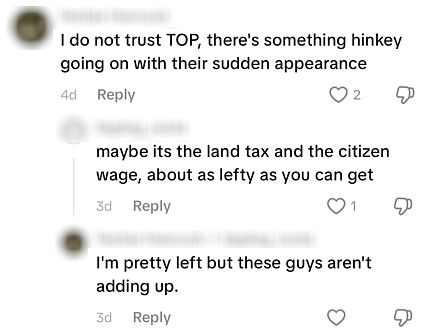
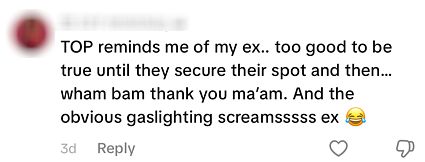
Consider these two statements, one by a person who thinks Opportunity is “hinkey” but can’t say why, and the other person who can say exactly why they’re suspicious – the entire party reminds them of their ex-partner… 

In another, I recently challenged a few folks’ comments on a TikTok video by a person who stated they were suspicious of Opportunity because they don’t have the grassroots movement foundational background that our leftist parties have. Consider that Labour started as a union movement, the Greens with environmental activism and the preceding Values party, and Te Pati Māori with the foreshore and seabed protest movement. 

I called it out as unfair that anyone should expect a party that explicitly rejects the left vs right distinction to have the same background as our left leaning parties have. Boy was that a mistake. The replies I got beautifully illustrated the problem I’m speaking of here. 
As a brief aside, I wish to emphasise that I have no problem with people rejecting Opportunity at the election because they don’t have this background. Any reflective and conscious deliberation that informs an election choice, I think, is virtuous and to be encouraged. What I was rejecting, was the imposition or expectation that a party explicitly marketing itself as neither left nor right conform to the virtues desired by the left. 
And I’ll admit, I got frustrated at being mocked and called stupid etc because I’m well aware that that isn’t the case. I prematurely used terms like “psychosis” and “hysteria” alongside “paranoia” before concluding, after the following days, that the latter label was justified but the other two were more clinical and perhaps unfairly antagonistic or provocative. However, I defend my claims at the time – when one is the subject of pile-on’s by people who insist you are stupid and evil and “the problem”, one doesn’t have the necessary solitary space to pause, reflect, and compile an honest – less reactionary – response. 

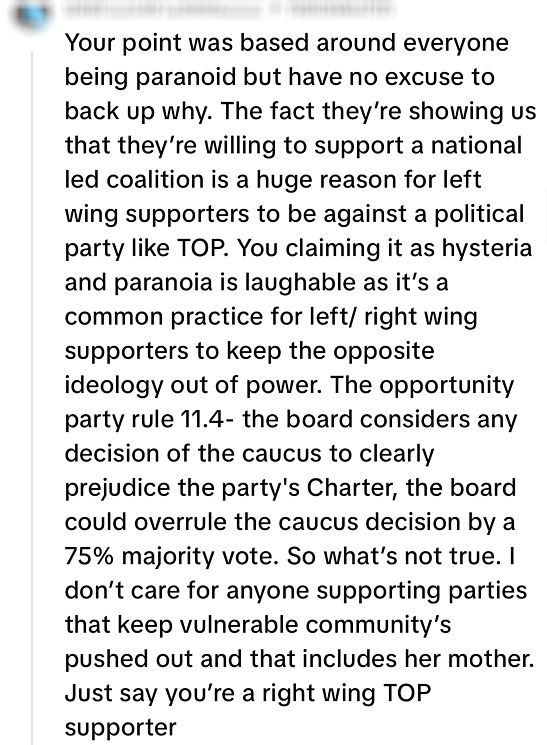
This response illustrated above touches at another fallacy I’ve noticed – and frankly find myself utterly outraged by. Firstly, I’ll point out that the board veto was ditched weeks, if not months, ago – following outrage that stemmed from its public revelation. So, continuing to insist this is the case is frankly fake news. Secondly, saying it’s “common practice” for left- and right-wing supporters to keep the opposite out of power both misunderstands the motives of some voters (as I’ve outlined), and continues to demonstrate our misunderstanding of what centrism is. 

But the aspect of this I wish to draw out is the mention of Wong’s mother. I’ve seen this criticism several times – including entire TikTok videos pointing this out. Qiulae Wong’s mother worked for Judith Collins – a former National MP, minister, and party leader. There is a consistent implication that as her mother sided with a National party figure, she too will inevitably do so. 

I find this suggestion not just logically unsound, but morally repulsive. 
We are all individuals with choices, choices that may well be influenced by our circumstance – but circumstance can only ever write the menu of choices upon which we decide between. Our parents’ occupation does not, never has, and never will, determine the choices we make. To reduce an entire person to the occupation of her mother is one of the most repulsive suggestions I’ve ever heard of. 
We are not our parents. 
We succeed them. 
Our world view transcends theirs. 
By this I mean we start off inheriting their views - but as we develop, we formulate our own views and ultimately grow beyond theirs. 
I recall a quote by Yoda in a Star Wars movie “We are what they grow beyond. That is the true burden of all masters”. It’s a beautiful quote. Each generation succeeds the previous in every possible way – they are not the same. 
However, I concede that if one is entirely, or even partially, outcome-focused when it comes to elections, then being worried about who will form a government in a months’ time, is reasonable.
It’ll be a tight election.
Many folks are desperate for the left to stay out of government, and just as many seem desperate for them to get into government. My objection is that getting caught up in this anxiety and insisting that everyone must see the election in these terms is disrespectful and narrow minded. 

Before anyone comes at me, I don’t say this from a position of material privilege. I’ve been on a benefit more times in my life than almost anyone I know, I’ve been homeless – lived in social housing, been so poor that I’ve had to sleep off hunger pains because there’s nothing to eat – and when there was, it was rotten food (anyone who’s been in this position can no doubt recall the intensely musky aftertaste of rotten meat – it stays with you for hours!). 

No, I’m not saying this because I have some cushy life that will be unaffected no matter the outcome this election. 
I daresay I’ll be affected more than most. 
So, I cannot be accused of coming from a position of immense privilege.
However, I do wish to be charitable.
So, let’s assume the instrumental mentality for a moment. Those on the left want a change of government – indeed many in the centre and perhaps on the right do too. 
I maintain that a change of government, even if National is the core component of the next one, comes with change in its composition. 
Even if a new party is added to it – it cannot be considered the “same” government.
I was going to use Labour’s last government as an illustration, both with and without NZF.
But given that its term without NZF to pump the brakes didn’t quite result in the golden age of progressivism that many of us hoped for, I don’t think that’s the best example to go with.
Regardless, you get my point – Opportunity being present in the next government, should it be National-led, is quite literally a change in government.
They will be the handbrake analogous to NZF in the 2017 Labour government.
I know folks have pointed out Luxon has ruled Opportunity out.

I suspect he’s been forced into that position after ruling them out vaguely in an offhand remark, and after several weeks has been compelled to use stronger and stronger language. However, I maintain that it’s not up to him who National works with post-election. He doesn’t get to decide – we do. 
That’s our job. 
We’re the dealer at a card game – we deal the cards, and he plays whatever he’s dealt. “Ruling in” or out any party before an election in coalition agreements is non-binding and merely performative.

I daresay, if it looks like National could form the next government but only with Opportunity’s help and Luxon maintains he ruled them out, he’ll be rolled simply because the rest of the caucus wants to remain in government – despite his impulsive declarations to the contrary.
It’s our job to decide what cards will be dealt – and I sincerely hope we all consciously reflect upon what matters to us the most and make the right choice by us – whether it’s through tactical voting or te tautoko I Kaupapa. Make a choice you can stand by – no matter the reason underlying it – and please stop making fun of people who’s well-intentioned and reflected upon choices leads them in another direction.